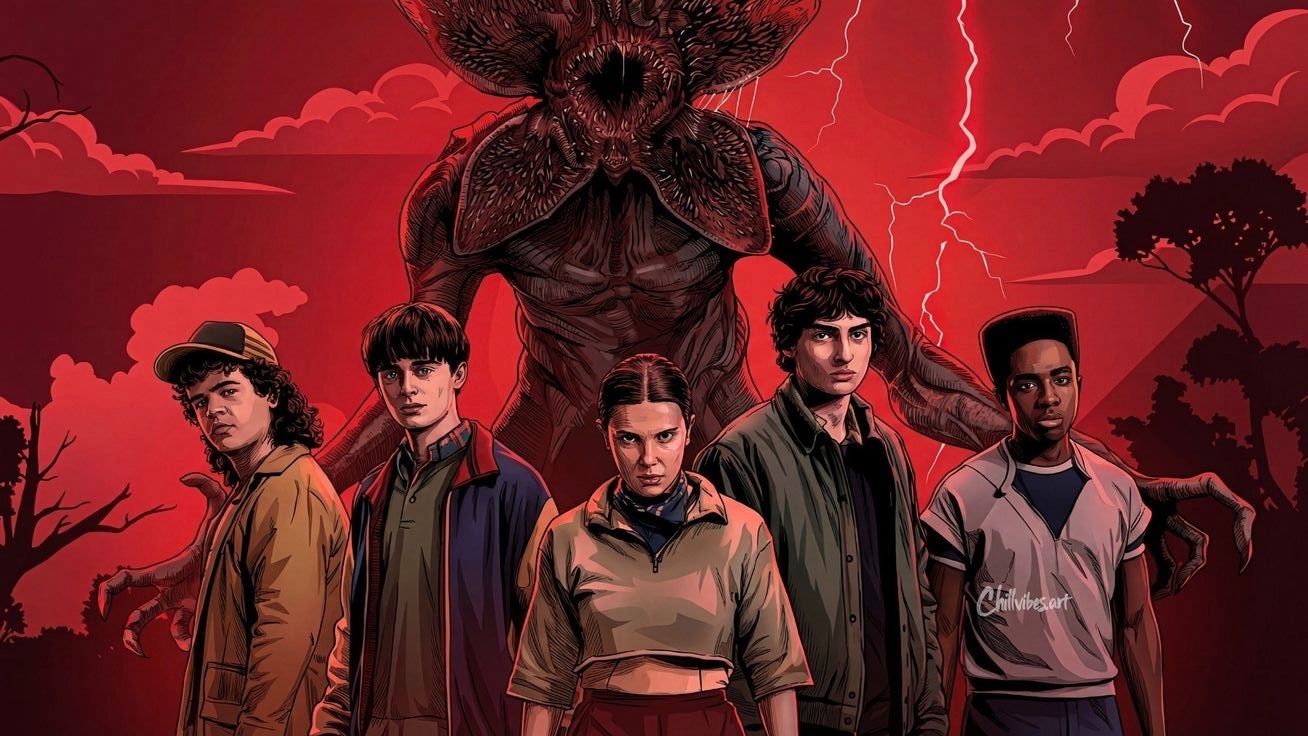
Stranger Things is one of the rare television series that manages to feel both expansive and intimate at the same time. From its very beginning, the show establishes itself as more than a nostalgic science fiction experiment. It presents a carefully layered story that blends mystery, horror, emotional drama, and coming-of-age themes into a single, cohesive narrative. Set in the quiet town of Hawkins, Indiana, the series begins with the disappearance of a young boy, a simple incident that slowly opens the door to a far more complex and dangerous reality. What starts as a personal tragedy soon reveals the existence of secret government experiments, supernatural forces, and a parallel dimension known as the Upside Down.
The genre of the series is one of its greatest strengths. It does not confine itself to a single category but instead moves fluidly between science fiction, psychological horror, mystery, and emotional drama. The supernatural elements are never presented just for spectacle. They function as symbols of fear, trauma, and the unseen consequences of human ambition. The Upside Down, in particular, acts as a dark reflection of the real world, representing everything that has been ignored, suppressed, or misunderstood. This careful use of genre allows the story to feel grounded even when dealing with extraordinary events.
What truly elevates the series is the quality of its writing. Every season builds naturally upon the previous one, expanding the world without losing narrative focus. Characters are written with depth and consistency, and their growth feels earned rather than forced. The children mature under the weight of repeated trauma, friendships are tested by fear and loss, and adults are forced to confront the consequences of their past decisions. No major storyline feels wasted, and even secondary characters are given emotional purpose within the larger plot. The writers show a clear understanding of long-term storytelling, where actions have consequences that carry forward rather than being conveniently forgotten.
As the story reaches its later stages, the emotional intensity increases significantly. The stakes are no longer limited to a single town or a single group of people. The conflict becomes existential, touching on themes of sacrifice, identity, and survival. Yet, despite the growing scale, the series never loses its emotional center. At its heart, it remains a story about human connection, loyalty, and the struggle to protect what matters most in a world that is constantly falling apart.
The conclusion of the series is particularly powerful because it feels complete without being overly final. The central conflicts are addressed, major character arcs reach meaningful resolution, and the audience is given a clear understanding of what has been won and what has been lost. The emotional journey feels fulfilled. At the same time, the ending deliberately avoids offering total closure. The danger is diminished but not entirely erased, and the world of Hawkins is permanently changed. This lingering uncertainty functions as a quiet cliffhanger, not designed to confuse the audience, but to remind them that some consequences cannot be undone.
The overwhelming feeling left by the ending is not frustration, but reflection. The story concludes in a way that respects the intelligence and emotional investment of the audience. It acknowledges that real endings are rarely neat or perfectly resolved. By choosing restraint over excess explanation, the writers allow the themes of the series to resonate long after the final scene.
In the end, Stranger Things succeeds because it understands the difference between an unfinished story and an intentionally open one. It delivers a complete narrative experience while leaving space for imagination and emotional afterthought. This balance between closure and uncertainty is what makes the series so memorable and so well written. It does not simply end. It lingers.